 +92 330 4739908
 +92 330 4739908


Why We are Writing This Article
This is one of the most common and quietly stressful questions parents ask: “At what age should my child start learning the Quran?” Some parents worry they waited too long. Others fear they started too early. Many feel pressure from relatives, comparisons with other children, or timelines promised by Quran academies. Search online for what age to start Quran, and you’ll find a different confident answer on almost every page. And underneath it all is a silent concern: What if I’ve already made the wrong decision? Most parents just want a straightforward answer to what feels like a simple question: what is the best age to start learning Quran? It’s really the same question in different words: when should a child start learning Quran, and how do you know you’ve made the right call?
When parents search for answers, they usually find confident but conflicting claims:
- “Start at age 3.”
- “Five is ideal.”
- “After seven, it’s already late.”
But Quran learning does not work according to fixed numbers. Neither Islamic scholarship nor child development supports a single age that applies to every child. This article offers a clearer, calmer answer grounded in scholarly guidance, child psychology, and real-life parenting so you can make decisions based on understanding, not pressure.
Why There Is No Single Right Age for When a Child Should Start Learning Quran
Let’s start with what matters most for parents to hear clearly:
There is no universal age at which every child should begin learning the Quran. Not three. Five doesn’t guarantee it either. Neither does seven.Children develop differently emotionally, cognitively, and linguistically. Some are ready earlier; others need more time. Both can grow into confident, respectful learners of the Quran when guided appropriately.
So why do age-based rules feel so common?
Because numbers feel reassuring. They offer certainty in a space filled with anxiety. Cultural habits, comparison with other children, and simplified advice often turn a complex developmental process into an easy rule. But easy rules rarely reflect how learning actually works.
The more helpful question is not: “How old is my child?” It is: “What kind of Quran learning is appropriate for my child right now?” Readiness not age shapes success. In other words, the best age for Quran learning isn’t a number at all, it’s a stage of readiness every child reaches differently.
What Scholars Actually Emphasized: Readiness Before Results
Many parents assume classical scholars set strict starting ages. In reality, Islamic scholarship consistently emphasized readiness, not numbers. Early exposure to the Quran was encouraged, but formal instruction was approached gradually and wisely. Scholars warned against rushing children into memorization or correction before they could meaningfully engage.
Across generations, four principles appear repeatedly:
Gradual Introduction
Children benefit from first becoming familiar with the sound and rhythm of the Quran. Listening and gentle repetition were valued before formal demands.
Love Before Targets
Scholars prioritized a child’s emotional connection to the Quran over speed or volume of memorization. Forced learning was discouraged.
Correct Guidance Over Early Start
Beginning later with proper instruction was considered better than beginning early with confusion or poor habits.
Individual Differences Matter
Children differ in temperament, attention, and maturity. Instruction was meant to adapt to the child not the other way around.
This guidance closely mirrors what modern child psychology confirms today.
What Child Psychology Confirms About How Children Learn
Studies on early childhood readiness to memorize the Quran from a learning psychology perspective
Modern research supports a key idea scholars already understood: Children learn best when instruction matches their developmental stage.
Young children absorb language primarily through observation and listening. This is known as observational learning a well-established principle in developmental psychology. Infants and toddlers learn sounds, rhythms, and patterns long before they can reproduce them accurately.
This is why early exposure to the Quran is so powerful.
- Listening comes before reading
- Repetition comes before accuracy
- Understanding comes gradually over time
Attention span and emotional safety also matter. Short, calm interactions build confidence. Long or pressured sessions often create resistance. Children who feel safe and encouraged learn more effectively than those who feel rushed or compared.
Together, scholarship and psychology point to the same conclusion: Learning works best when it follows development not the calendar.
The Biggest Mistake Parents Make: Confusing Exposure With Formal Learning
Research on developmental stages of language and reading readiness in early childhood
One of the most common mistakes parents make is assuming that exposure and formal learning are the same thing. They are not.
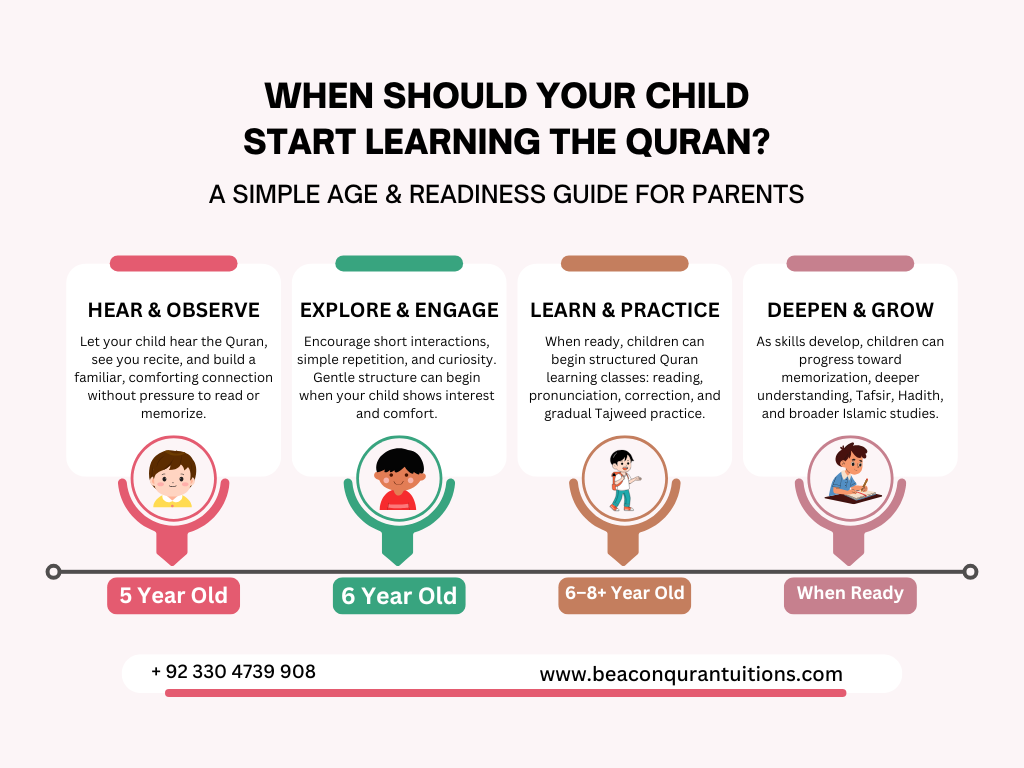
Exposure: The Observational Stage (Birth to ~5 Years)
Exposure means allowing a child to hear and observe the Quran without expectation. This stage can begin in infancy.
- A baby listening while a parent recites
- Toddlers hearing Quran recitation at home
- Young children watching a parent read after prayer
An 11-month-old does not need lessons. A two- or three-year-old does not need correction. But hearing the Quran regularly during bedtime, in the car, or played softly at home helps the child recognize it as familiar and comforting. This is foundational learning. The child is absorbing sound, rhythm, and emotional context. Parents can also gently reinforce these early experiences through age-appropriate Islamic learning at home, helping children connect Quran recitation with the values, stories, and teachings of Islam as they grow. A structured approach that combines the Quran with broader Islamic education can make this journey even more meaningful
Formal Learning: The Instructional Stage (Usually ~6–8+)
Formal Quran learning is different. It involves:
- sitting with intention
- focused repetition
- correction and feedback
- gradual application of rules
This is usually where families begin looking into structured Tajweed classes, since correct pronunciation and rules become part of the child’s daily practice at this stage. This stage typically becomes appropriate around ages 6, 7, or 8, depending on the child’s readiness and prior exposure. This is usually the real answer parents are looking for when they ask when to start Quran classes, not a fixed age, but a stage their child has clearly reached. Problems arise when these stages are confused when children are pushed into formal lessons before they are ready, or when exposure is mistaken for actual skill-building. When each stage is respected, learning becomes calmer, healthier, and more effective.
What the Right Goal Looks Like at Different Ages
Once exposure and formal learning are clearly separated, the next question becomes practical: “What should my child be doing right now?”
Early Years (Birth–5): Comfort and Familiarity
The goal is not reading. It is an emotional connection. Listening, recognition, and calm association matter most.
Growing Years (5–6): Engagement and Readiness
Children begin to sit briefly, repeat sounds, and show curiosity. Light structure may appear without pressure.
Learning-Ready Stage (6–8+): Skills and Independence
Formal instruction makes sense here. Letters, corrections, rules, and independent reading develop steadily when the foundation is in place. Progress feels natural because it is built, not rushed. Many parents use this stage as the natural entry point into Hifz, since a child who reads independently is usually ready to begin memorizing with real understanding, not just repetition. Once parents see it laid out this way, the question of the right age to start Quran for kids stops feeling like guesswork and starts feeling like common sense.
Starting Too Early or Too Late: What Parents Should Know
Many parents worry they have missed the “right window.” Here is the truth: Starting formal lessons too early without readiness can create resistance. Starting later with the right approach is rarely harmful. With positive exposure and a calm, structured method, older beginners often progress quickly and confidently.
What parents should remember:
- Readiness matters more than age
- Exposure at any age supports later learning
- Pressure delays progress; patience supports it
Signs a Child Is Ready for Formal Quran Learning
Readiness shows in response, not performance. A child who is ready often shows:
- ability to sit and listen briefly
- willingness to repeat without frustration
- comfort with guidance and correction
- emotional safety and confidence
- genuine curiosity
When these signs are present, formal learning becomes a natural next step. When they are not, waiting is preparation not delay.
Final Thoughts: The Quran Is a Lifetime Relationship, Not a Childhood Deadline
Why Quran Learning Is Not a Race
The Quran was never meant to be rushed through childhood. It is a relationship that unfolds over a lifetime.
A Parent’s Real Responsibility
Your role is not to meet timelines or comparisons. It is to protect your child’s relationship with the Quran so it is built on love, understanding, and consistency.
The Quran Is Meant to Be Returned To
The Quran is not something a child finishes early. It is something they return to again and again throughout life. When learning follows readiness and wisdom, no stage is wasted and no beginning is ever truly too late. For families looking to build that lifelong relationship in a structured way, a complete learning path that pairs Quran study with broader Islamic studies can offer exactly that steady, unhurried foundation.