Arabic Qaaida & Tajweed ul Quran Course
Learn Quran with Tajweed Online Because Every Letter Counts
Your child recites. The words come out. But something feels off — a letter pronounced loosely here, a rule skipped there. You sense it, even if you cannot name it. This is where most Quran journeys quietly stall. When you choose to learn Quran with Tajweed online, you are not just fixing pronunciation. You are giving your child a recitation that is correct, confident, and built to last a lifetime. At Beacon Quran Tuitions, our online Quran classes with Tajweed in USA are structured around exactly this gap between reading the Quran and reading it right.
Students
0
+
Teachers
0
+
US Experience
0
+
US States
0
+
From Hesitation to Fluency
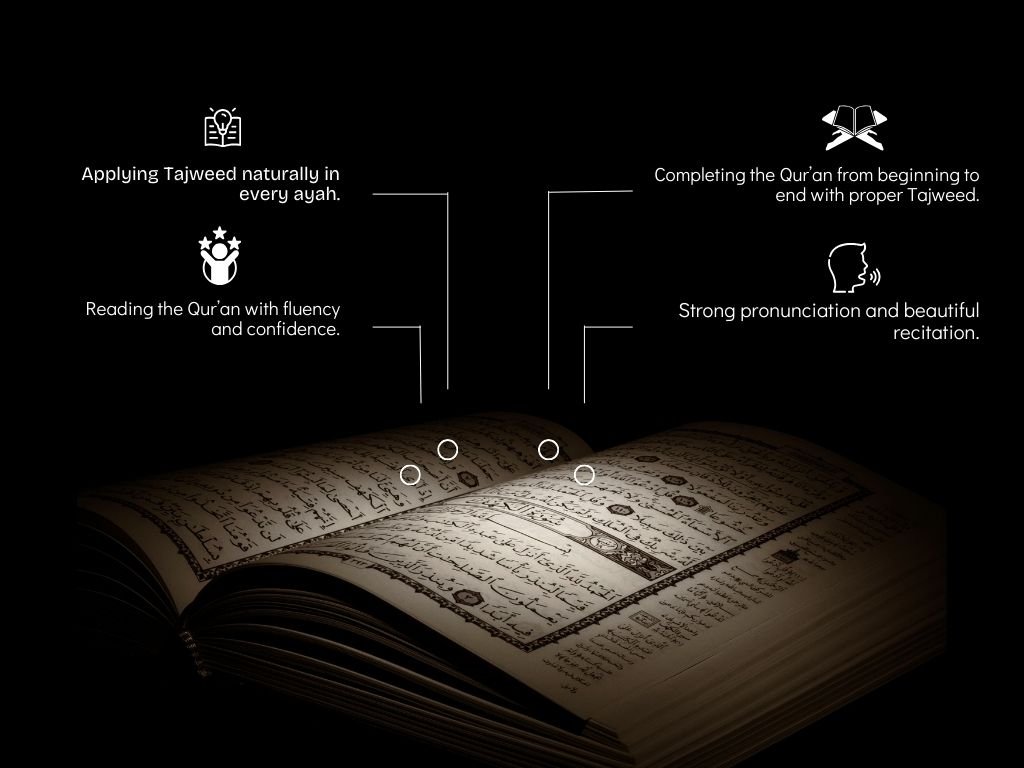
Most children finish years of Quran classes still hesitant in their recitation. Our Online Tajweed Classes are designed to change exactly that. When families choose to learn Tajweed online, the difference lies in how the rules are taught, not memorized in isolation, but applied naturally in every ayah. From fluency and confidence to strong pronunciation, our Quran pronunciation classes online and complete Online Quran Tajweed Course take students from hesitation to a recitation they will carry for life.
Master Tajweed from the Basics. Let’s talk about this.
Course Outline
This Course Is For
Modern and Creative
Course Outline
Every student who joins our online Quran reading with Tajweed course begins from the same place as the foundation. Because no rule lands correctly without it.
Stage 01 — Qaida Nooraniya (The Foundation)
Before a child reads a single ayah, they need to understand the building blocks of Arabic recitation. Our Quran Classes with Tajweed for Kids begin here, with the Qaida Nooraniya a globally trusted primer developed by Sheikh Noor Muhammad Haqqani that takes students from zero to confident reading, step by step.
This stage covers:
Arabic Alphabet (Huroof e Mufridaat) Recognition of all 29 Arabic letters in their individual and connected forms. A student learns that the letter ب (Ba) changes shape depending on whether it appears at the beginning, middle, or end of a word but its dot always stays below.
Compound Letters (Huroof e Murakkabat) Letters joined together as they appear inside actual Quranic words. Students practice reading combinations rather than isolated letters.
Harakaat (Short Vowels): Fathah (zabar), Kasrah (zer), and Dammah (pesh). These are the short vowel markings that give each letter its sound. Example: بَ (ba) vs بِ (bi) vs بُ (bu).
Sukoon & Tanween: Sukoon marks a resting letter with no vowel sound. Tanween adds a terminal “n” sound to words. Example: كِتَابٌ (Kitaabun).
Madd Letters (Long Vowels): Alif, Waw, and Ya when used to extend a sound. Example: نُوحٌ (Nooh) the Waw extends the “oo” sound.
Mushaddadah (Shaddah): A letter written once but pronounced twice with full emphasis. Example: الرَّحْمَنِ the Ra carries a Shaddah and must be held firmly.
Makharij al-Huroof (Articulation Points): Where in the mouth and throat each letter originates. Example: ح (Ha) comes from the middle of the throat, while ب (Ba) is formed at the lips.
Stage 02 — Core Tajweed Rules (Applied Recitation)
Once the foundation is firm, students move into the rules that shape Quran recitation with Tajweed online. These are not memorized in isolation; they are practiced directly inside Quranic text.
Noon Sakinah & Tanween Rules: Four rules govern how Noon Sakinah (نْ) and Tanween behave depending on the letter that follows:
- Izhaar (Clear Pronunciation): Noon is pronounced clearly when followed by throat letters (ء ه ع ح غ خ). Example: مَنْ آمَنَ — the Noon is read clearly before Hamza.
- Idghaam (Merging): Noon merges into the following letter. Example: مَنْ يَعْمَلْ the Noon blends into the Ya.
- Iqlaab (Conversion): Noon converts to a Meem sound before ب. Example: مِنْ بَعْدِ read as “Mim Ba’di.”
- Ikhfa (Concealment): Noon is softened and partially hidden before 15 specific letters. Example: مَنْ كَانَ the Noon is neither fully clear nor fully merged.
Meem Sakinah Rules
- Ikhfa Shafawi — Meem is concealed before ب. Example: تَرْمِيهِم بِحِجَارَةٍ — the Meem is softened before Ba.
- Idghaam Shafawi — Meem merges into another Meem. Example: لَهُم مَّا — both Meems become one held sound.
- Izhaar Shafawi — Meem is clear before all other letters.
Ghunnah (Nasalization) — A nasal sound held for two counts whenever Noon or Meem carries a Shaddah. Example: إِنَّ — the Noon with Shaddah carries a full Ghunnah.
Rules of Raa (ر) — Raa is either heavy (Tafkheem) or light (Tarqeeq) depending on its vowel and surrounding letters. Example: رَبِّ (heavy) vs رِجَالٌ (light).
Rules of Laam — The Laam in اللَّه is heavy after Fathah or Dammah (اللَّهُ) and light after Kasrah (بِسْمِ اللَّهِ).
Stage 03: Madd Rules (Prolongation)
Madd governs how long certain sounds are held during recitation. Getting this right is what separates mechanical reading from genuinely beautiful Quran recitation with Tajweed online.
Madd Tabee’i (Natural Madd): Two counts. Always present when Alif, Waw, or Ya follows its matching vowel. Example: قَالَ — the Alif extends the “aa” for two counts.
Madd Muttasil (Joined Madd): Four to five counts. A Madd letter followed by Hamza in the same word. Example: جَاءَ — the Alif before Hamza must be extended.
Madd Munfasil (Separated Madd): Four to five counts. Madd letter at end of one word, Hamza at start of the next. Example: إِنَّا أَعْطَيْنَاكَ.
Madd Laazim (Obligatory Madd): Six counts. Always. Example: الضَّالِّينَ — the Laam with Shaddah requires a full six-count extension.
Stage 04: Waqf & Ibtida (Stopping & Starting)
Where to pause and where to continue is one of the most overlooked yet meaning-critical skills in Quranic recitation. A misplaced stop can alter the meaning of an ayah entirely. Students learn recognized stopping signs from the Uthmani script and practice applying them fluently.
Stage 05: Tarteel & Full Quran Reading
The final stage brings everything together. Students move through the Quran from Surah Al-Fatiha to Surah An-Naas with all Tajweed rules applied naturally not rule by rule, but as one fluid, confident recitation.
For families who prefer a female Quran teacher for Tajweed, all stages of this course are available with our qualified female instructors ensuring every student learns in an environment that feels safe, comfortable, and right for their family.
This Course Is For
- Children and adults who recite but have never formally learned Tajweed
- Students who can read Arabic but struggle with correct pronunciation
- Parents who sense errors in their child’s recitation but cannot identify them
- Anyone who has been reading the Quran for years without structured Tajweed guidance
- Beginners starting from the Qaida Nooraniya with zero prior knowledge
What You Can Expect
- One-on-one Tajweed classes online where errors are identified and corrected in real time, every session
- Rules taught inside actual Quranic text, not in isolation
- A structured path from Qaida foundation to full Quran recitation
- Measurable progress that parents can see and students can feel
- A recitation that is not just readable but right
Modern and Creative
For many new Muslims, flexibility matters. That’s why we offer class timings that fit your routine, and one-on-one sessions where you can learn comfortably without hesitation. You’ll also receive regular progress updates, so you can see how your reading and recitation are improving month after month. At Beacon Quran Tuition, we believe every learner, whether a child, adult, or new Muslim, deserves a welcoming start with the Quran.
Explore all Online Quran Courses here:
BQT Pricing
Plan A
$
20
Monthly
-
2 Days Weekly (You Choose the Days)
-
30-Minute One-on-One Classes
Plan B
$
30
Monthly
-
3 Days Weekly (You Choose the Days)
-
30-Minute One-on-One Classes
Plan C
$
40
Monthly
-
4 Days Weekly (You Choose the Days)
-
30-Minute One-on-One Classes
Plan D
$
50
Monthly
-
5 Days Weekly (You Choose the Days)
-
30-Minute One-on-One Classes
Popular
Enjoy a 20% family discount when enrolling more than one student.
Frequently Asked Questions
It depends on your pace. Most students see clear improvement within 3 to 6 months.
Yes, kids as young as 5 can start learning Tajweed simply and engagingly.