 +92 330 4739908
 +92 330 4739908



It Starts with a Simple Google Search
Imagine it’s one of those ordinary evenings. The kids have finally gone to bed, the house is a little quieter, and you have a few minutes to yourself. You’ve been thinking about your child’s Quran learning for some time. Maybe they are just starting and you want to find the right teacher. Maybe they have already been learning, but you’re not completely satisfied with the current arrangement. Or perhaps your schedule has changed and online Quran classes in the USA simply seem like a better fit for your family. So you sit down, open Google, and type a simple search: “How much does it cost?” That is where the question of online Quran classes cost in USA begins to matter not just because you want to know the monthly fee, but because you want to understand what your family is actually getting for it.
Why the Price Gap Is So Confusing
Suddenly, you have dozens of options in front of you. You open one website. $30 per month. Another says $45. And another $60. Then you find an academy charging $75 or $80. And now you pause. The question is no longer simply, “How much do online Quran classes cost?” It becomes: “Why is there such a big difference?” You start comparing. Is $30 actually a good deal? Is $60 too expensive? If one academy charges twice as much as another, does that mean your child will receive twice the quality of education? Or are the two academies simply offering different things? And perhaps the question that matters most: How do you know what is actually worth paying for?
You’re Not Just Paying for a Quran Class
When you choose Quran classes online in the USA, you are not really buying a monthly subscription. You are choosing the person who will teach your child how to pronounce the words of the Quran correctly, apply Tajweed, read with confidence, and, hopefully, develop a relationship with the Quran that stays with them for years. Naturally, you don’t want to choose based on price alone. But you also don’t want to spend more than necessary on something you could get elsewhere for less.
Understanding What Your Fee Actually Covers
That is why the question of online Quran classes fees in the USA deserves a more thoughtful answer than a simple average monthly fee. In this article, we’re going to look at what online Quran classes in the USA generally cost, why those prices vary, what different price points can offer, what parents should watch out for when a price seems unusually low, and finally, where BQT’s own $50 monthly fee goes. Because once you understand what you are actually paying for, the numbers become much easier to judge.
What Does the Online Quran Classes Cost in USA Actually Depend On?
Before comparing $30, $50, $70, or any other monthly fee, ask first: What am I actually getting for that money? Understanding the online Quran classes cost in USA is only the starting point. The more important part is knowing what each academy includes in its monthly fee. What am I actually getting for that money? Consider two academies. Academy A charges $35 a month. Academy B charges $60. At first glance, the cheaper option looks attractive. But now look beyond the number. What if Academy A provides two short classes a week, while Academy B provides five? Perhaps one mainly focuses on completing the day’s lesson, while the other includes revision, independent reading, Tajweed correction, and regular progress feedback.
There is also the question of teacher consistency. What if teachers change frequently at one academy, while the other provides consistent one-to-one instruction with a teacher who knows exactly where your child is struggling? The monthly fee hasn’t changed. But the learning experience has. This is why parents should compare what sits behind the price, not just the price itself.
A Lower Fee Does Not Automatically Mean Better Value
There is nothing wrong with wanting affordable online Quran classes. Every family has a budget, and finding a good program at a reasonable price is a sensible decision. The problem comes when parents compare nothing but the monthly fee. A $30 program may be a very good choice if it provides the number of classes your child needs, qualified teachers, proper correction, consistency, and meaningful progress. Likewise, paying $70 or $80 does not automatically guarantee a better education. Ask yourself:
- Is the class genuinely one-to-one?
- Does the teacher listen carefully to pronunciation and Tajweed?
- Is the child learning to read independently?
- Has the academy built a structured curriculum?
- Does the teacher know what the child needs to improve?
- Is progress being monitored?
- Do parents receive meaningful feedback?
A Quran lesson is not valuable simply because a teacher and child spend thirty minutes together on a video call. What matters is what happens during those thirty minutes.
You Are Paying for More Than Minutes on a Screen
When parents look at a Quran academy’s pricing page, the easiest things to compare are the things they can count: $40 per month. Three classes a week. Thirty minutes per class. But those numbers cannot capture some of the most important parts of a child’s education. A qualified teacher who notices that a child repeatedly confuses two Arabic letters is providing something different from a teacher who simply moves to the next page.
The Difference a Focused Teacher Makes
A teacher who realizes that a child understands a Tajweed rule but cannot yet apply it independently is doing more than checking whether the lesson was completed. And a teacher who keeps track of recurring mistakes and adjusts future lessons accordingly is providing a learning process, not simply a series of video calls. That difference is difficult to put on a pricing table. So when comparing academies, look beyond the number of classes. Consider the teacher, curriculum, correction, communication, progress tracking, scheduling, and support that come with those classes. The online Quran lessons cost may look attractive on paper, but the learning experience behind those lessons is what ultimately matters.
The Same Number of Classes Can Still Mean Different Learning
There is another point parents often overlook. Even if two academies offer the same number of classes for the same duration, the actual learning can still be very different. Consider two 30-minute lessons. In the first, the child reads while the teacher listens, corrects a few obvious mistakes, and moves on. In the second, the teacher begins with a short revision, listens carefully to pronunciation, identifies recurring errors, asks the child to read independently, explains a Tajweed rule when needed, and finishes by checking whether the child can apply what was learned.
Both lessons lasted 30 minutes. But thirty minutes of teaching is not automatically equal to thirty minutes of learning. This matters particularly in Quran education because skills such as Makharij, Tajweed, fluency, and memorization develop through careful listening, correction, repetition, and gradual independence. A child can spend hundreds of minutes in online Quran lessons in the USA without making the progress a parent expects if those minutes are not being used effectively.
What Should Parents Compare?
Before deciding whether a Quran academy is affordable or expensive, look at the complete learning arrangement.
- How much live teaching time am I actually receiving each month?
- Is the class one-to-one or shared with other students?
- Who is teaching my child, and what experience or qualifications do they have?
- How is Tajweed taught and corrected?
- Does the teacher adapt the lesson to my child’s level?
- Is my child learning to read independently, or mainly repeating after the teacher?
- How is progress measured?
- Will I know what my child is improving and where they still need help?
- What happens when my child misses a class?
- Are there additional charges for registration, materials, or other services?
These questions give you something much more useful than a simple price comparison. You’re no longer looking at $35 versus $60. You’re looking at what your child will actually experience week after week. That is a much more meaningful way to understand the Quran classes price in USA.
Price Matters, But Context Matters Too
Of course, price still matters. Every family has a budget, and a Quran education program should be financially realistic for the household. Parents should never feel pressured to spend beyond their means simply to give their child a good Quran education. The better question is: “Which program gives my child what they actually need at a price our family can comfortably sustain?” Now that we have established what parents should look for, let’s turn to the numbers themselves. How much do online Quran classes cost in USA, and what should families expect to receive at different price points? We’ll start with the general pricing landscape before looking at what happens when a price seems unusually low.
When a Very Low Price Starts Costing Your Child More
There is nothing wrong with looking for affordable Quran classes. But when an academy’s price is significantly lower than the alternatives, it is worth asking one simple question: “What makes it possible for them to charge so little?” Sometimes the answer is perfectly reasonable. The academy may operate from a country with lower costs, have a leaner structure, or simply work with a lower margin. But sometimes the savings come from cutting back on the very things that influence a child’s education. And that is where a low monthly fee can become costly in ways that are not immediately visible.
1. Lower Costs Can Mean Less Investment in Teachers
A good Quran teacher is not simply someone who can recite the Quran. They need strong Quranic knowledge, correct pronunciation, experience teaching children, clear communication, patience, and the ability to identify and correct mistakes properly. Maintaining that standard requires careful recruitment, supervision, and teacher development.
When an academy has very little room in its pricing model, it tends to neglect those areas. The result may be teachers who are inexperienced, difficult to understand, poorly supported, or inconsistent in their teaching. And remember: your child may listen to that teacher several times a week for years. The teacher’s pronunciation, communication, and teaching habits can become part of the child’s own learning.
2. Inconsistent Classes Break Learning Momentum
A class that starts late, gets cancelled frequently, or is repeatedly rescheduled may seem like a small inconvenience. For a child learning Quran, it can become something bigger. Pronunciation needs repetition. Tajweed needs practice. Memorisation needs revision. Reading improves through consistency. When classes repeatedly get interrupted, that momentum is lost. The child may have to spend valuable lesson time revisiting material instead of building on it. So don’t only ask: “How much does each class cost?” Also ask: “How reliably will my child’s classes actually happen?”
3. Poor Correction Can Turn Small Mistakes Into Long-Term Habits
One of the easiest ways to make a child look like they are progressing is simply to keep moving through pages. But completing pages is not the same as learning to read correctly. A good teacher listens carefully, identifies recurring pronunciation and Tajweed mistakes, corrects them, and checks whether the child can reproduce the correction independently. If a teacher gives only superficial corrections or follows the same read-and-repeat routine every day, mistakes can continue for months without their underlying cause being addressed. The child is moving forward through the Quran. But the reading skill may not be moving forward with them.
4. Missed Classes Can Quietly Turn Into Lost Months
One missed class is not a disaster. Repeated missed classes are different. When teachers are frequently unavailable or lessons are repeatedly cancelled, those missed sessions accumulate. Days become weeks, and weeks become months. Parents may not notice the effect immediately. Then, much later, they may wonder why their child is still struggling with something that should have been mastered much earlier. Consistency is not a luxury in Quran learning. It is part of the learning itself.
5. The Biggest Cost: Years of Classes Without Strong Reading
This may be the most important concern of all. A child can attend Quran classes for one year, two years, or even longer and still struggle to read independently if the foundation was never properly built. Maybe the Qaida took far too long. Pronunciation mistakes may never have been properly corrected, or the teacher may have kept moving forward despite weak fundamentals. Eventually, the child may have to go back and rebuild skills that should have been established years earlier.
And that is where a very cheap class can become surprisingly expensive. You may save money every month, but lose something much harder to recover: your child’s time, confidence, and learning momentum. The goal should never be to finish Qaida or the Quran as quickly as possible. The goal is to make sure that when a child moves forward, they are actually moving forward with the skills they need.
Why Online Quran Classes From the Middle East and South Asia Can Be a Blessing for U.S. Families
There is another side of this pricing conversation that parents should understand. A lower fee does not necessarily mean lower-quality Quran education. One of the major advantages of Quran learning online in the USA is that a family in the USA can connect with qualified Quran teachers living in countries where the overall cost of providing an education service is considerably lower.
Pakistan, India, Bangladesh, Egypt, and other Muslim-majority countries have large communities of Quran teachers, Arabic teachers, Tajweed specialists, and Islamic educators. Many have spent years studying and teaching the Quran, while the cost of living and operating a professional service business in their countries can be very different from the United States. That difference can benefit both sides. A U.S. family does not necessarily have to pay U.S.-level private tutoring prices to access a highly capable Quran teacher.
Lower Cost Does Not Have to Mean Lower Standards
This distinction matters. There is a difference between: “This academy is cheap because it provides poor teaching.” and: “This academy can charge less because its operating costs are lower.” Those are completely different situations. An experienced Tajweed teacher in Lahore, Cairo, Dhaka, or another lower-cost market can provide excellent one-to-one Quran instruction to a child in Texas, New York, Virginia, California, or anywhere else in the USA.
The internet has removed the geographical barrier. A teacher does not have to live in the same city or even the same country to listen to a child’s recitation, correct Makharij, explain Tajweed, review memorization, or guide independent reading.
The USA and South Asia Are Not Comparing the Same Cost Structures
A parent in the USA lives in a very different economic environment from a teacher living in Pakistan or Egypt. Even within the U.S. tutoring market, labor itself represents a significant part of the cost of providing education. The U.S. Bureau of Labor Statistics reported a median annual wage of $43,350 for tutors in May 2025.
This is one reason international online education can work so well. A U.S. family can receive professional instruction at a price that fits its budget, while a qualified teacher can earn a meaningful income within their own economy. Everyone can benefit from that arrangement when the academy maintains proper standards. In other words, Quran tuition fees in USA can reflect very different underlying cost structures depending on where and how the education is delivered.
What Should You Expect from Affordable Online Quran Classes in USA?
For many Muslim families in the USA, this is one of the most practical advantages of online Quran learning. A family can remain in the comfort of its own home, choose a convenient schedule, receive one-to-one instruction, and connect with a qualified Quran teacher thousands of miles away. And in many cases, they can do so for considerably less than comparable private tutoring in the United States.
That is not automatically a compromise. When the teacher is properly qualified and the academy maintains strong standards, it can be an extremely effective model of education. So the question isn’t simply: “Why is this academy cheaper than a U.S.-based option?” A better question is: “Is the academy using its lower operating costs to make quality Quran education more accessible, or is it using a low price to justify low standards?” That distinction can save parents a great deal of confusion.

Where Does BQT’s $50 Monthly Fee Actually Go?
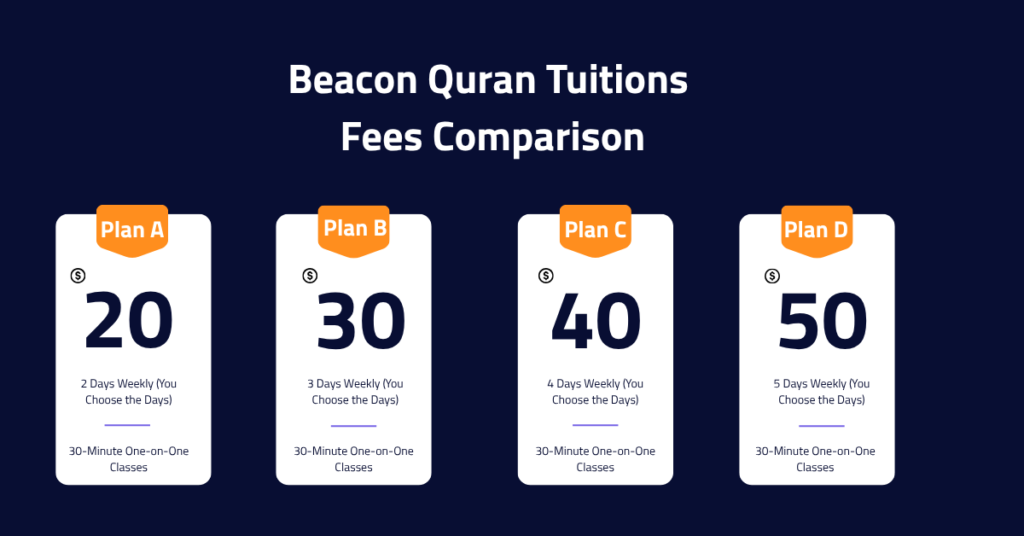
Now let’s bring the conversation closer to home. At Beacon Quran Tuitions (BQT), our standard fee is $50 per month for five days of one-to-one Quran classes each week. When parents compare the online Quran classes cost in USA, they naturally want to know what a $50 monthly fee actually includes. That is a fair question, and we believe parents deserve a clear answer. But that $50 does not simply pay for a teacher to appear on a screen for thirty minutes a day. There is an entire system behind that class. And we believe parents deserve to understand what they are actually paying for. If you are trusting us with your child’s Quran education, you should not have to take our word for it when we say, “We provide quality education.” You should be able to see what we invest in and why.
1. We Invest Heavily in the People Who Teach Your Child
We believe an online Quran academy can never be much better than the people teaching its students. That is why teacher selection is one of the most important parts of our model. We look for teachers with strong traditional Islamic and Quranic backgrounds, including teachers who have studied through established madaris and traditional Islamic institutions. We value this foundation because Quran education is not something we want to treat like just another online subject.
But knowledge alone does not automatically make someone an excellent online teacher. A teacher may have deep Quranic knowledge and still need training to communicate effectively with a child sitting thousands of miles away. That is why our work with teachers continues after recruitment. We train them in areas such as:
Clear, understandable spoken English
Professional communication and pronunciation
Explaining difficult concepts in child-friendly language
Responding patiently to children’s questions
Encouraging children without intimidating them
Building respectful teacher-student relationships
Recognizing when a child is confused, tired, distracted, or losing confidence
Correcting mistakes without embarrassing the child
Encouraging independent Quran reading rather than endless teacher-led repetition
Structuring revision and reinforcement
Maintaining appropriate professional boundaries
Communicating meaningful observations to parents
Because being able to recite the Quran correctly and being able to teach a child correctly are two related but different skills.
2. We Don’t Want Your Child’s Teacher to Be Just a Voice on a Screen
There is another part of teaching that is difficult to put on a pricing page: connection. A child who feels comfortable with their teacher is more likely to ask questions, admit when they do not understand something, accept correction, and remain engaged. That does not mean removing professional boundaries. It means creating a respectful learning relationship in which the child feels comfortable enough to learn.
We encourage our teachers to understand the child in front of them. What motivates them? Where do they struggle? Which letters give them difficulty? Are they becoming more confident? Do they rush through words? Is attention starting to fade? Are they memorizing without developing stronger reading skills? These observations matter because children do not all learn in the same way. A teaching method that works beautifully for one child may need to be adjusted for another. That is why teacher training is not simply an internal expense for us. It is part of the education your child receives.
3. We Pay Our Teachers Properly Because Their Work Matters
We also believe good teachers should be treated as professionals. If we want teachers to remain committed, prepare properly, continue developing their skills, and build long-term relationships with students, their work needs to be valued accordingly. Fair compensation is part of that. A teacher who feels respected and properly compensated is more likely to remain committed to the institution and its students. And continuity matters. A child should not have to repeatedly start over with a new teacher who knows nothing about their previous progress. Teacher stability is part of educational quality.
4. Your Fee Also Helps Us Create Free Islamic Education for the Wider Community
BQT is not built only around conducting paid classes. We also believe that an institution involved in Quran education has a responsibility to contribute knowledge to the wider Muslim community. That is why we invest resources into educational content, social media education, guides, and detailed articles addressing questions Muslim parents and families genuinely search for. Questions such as:
- When should my child start learning Quran?
- How long does Tajweed actually take?
- How can parents know whether their child is genuinely improving?
- What should parents look for in an online Quran teacher?
- How can Quran learning become a lifelong relationship rather than simply a childhood obligation?
We don’t want every useful piece of knowledge to sit behind a payment. If a parent finds one of our articles through Google and receives a clear, honest answer to something that has been worrying them, we consider that part of our responsibility too.
5. A Portion of What We Earn Also Supports Students Who Cannot Afford Education
There is another reason we do not look at the entire $50 simply as revenue. Part of our resources goes toward helping needy local students access education. We believe financial circumstances should not automatically determine whether a child gets the opportunity to learn. So when a family pays for its child’s Quran education through BQT, that payment supports the service their own child receives, while also contributing to a wider institution that tries to help students who need educational assistance. For us, that gives the business a purpose beyond simply generating income.
6. Your $50 Also Pays for the System Behind a Punctual Class
When your child’s class is scheduled for 5:00 PM, we believe it should begin at 5:00 PM. That sounds obvious. But maintaining that consistency across an online academy requires administration. Someone has to manage teacher schedules, monitor attendance, follow up on missed classes, arrange substitutions, handle parent communication, and resolve problems as they arise.
Good administration is almost invisible when it works properly. You simply notice that the teacher is there. The class starts on time. The schedule remains organized. And your child’s education does not depend on whether someone happened to remember the appointment that day. That reliability is part of the service.
7. We Track What Your Child Actually Learns
We also don’t want your child’s progress to exist only in the teacher’s memory. Our teachers maintain records of lessons and student progress so that we can build a clearer picture over time. We can see what the child has learned, what has been revised, and where they are improving. Just as importantly, those records show which areas still need attention and whether pronunciation or Tajweed difficulties are appearing repeatedly. That information helps us prepare monthly progress reports for parents. Because parents deserve more than: “Your child is doing well.”
They deserve to know what “doing well” actually means. Progress reporting also creates accountability. If a child has been struggling with a particular area for several months, that should become visible. If the child is improving, that should be visible too. The purpose isn’t paperwork for its own sake. It is to make the child’s learning clear enough for parents to see.
8. We Invest in the Infrastructure That Keeps the Learning Experience Professional
And then there are the expenses parents rarely see. Scheduling systems. Teacher coordination. Student records. Parent communication. Quality monitoring. Technical support. Training materials. Administrative work. Educational content. Website maintenance. None of these appear in your child’s thirty-minute lesson.
But they help make that lesson possible. A professional online Quran academy in the USA is therefore more than a collection of teachers and video calls. It is a system built around making those teachers effective, accountable, and available to students consistently.
Don’t Choose the Cheapest Quran Class. Choose the Right Fit
So, how much do online Quran classes cost in USA? The answer can range considerably depending on the number of classes, lesson duration, teacher qualifications, one-to-one instruction, curriculum, and the level of support an academy provides. But the monthly number alone cannot tell you whether a program is right for your child. Start with the teacher. Then consider how consistent the classes are, how carefully your child’s reading is corrected, and whether the academy actually monitors progress. Pay attention to what happens when your child struggles.
And then look at the fee. At BQT, our $50 monthly fee for five days of one-to-one classes each week is designed around that complete learning experience. We don’t expect every family to choose us simply because we say our model is good. We would rather show you what goes into it. Because when you are choosing Quran education for your child, the best question isn’t simply: “How much will I pay?” It is: “What kind of education will my child receive for what I pay?” And that is the comparison that truly matters.